Admissions Overview
Begin Your Journey Toward a Career in the Legal Profession
Thank you for your interest in the Paralegal Education & Training Institute. We are excited to welcome students who are committed to building the knowledge, professionalism, and practical skills needed to succeed in today's legal profession.
Whether you are beginning a new career, advancing your current role, or returning to education, the Paralegal Education & Training Institute is here to support your professional journey.
Admissions Process
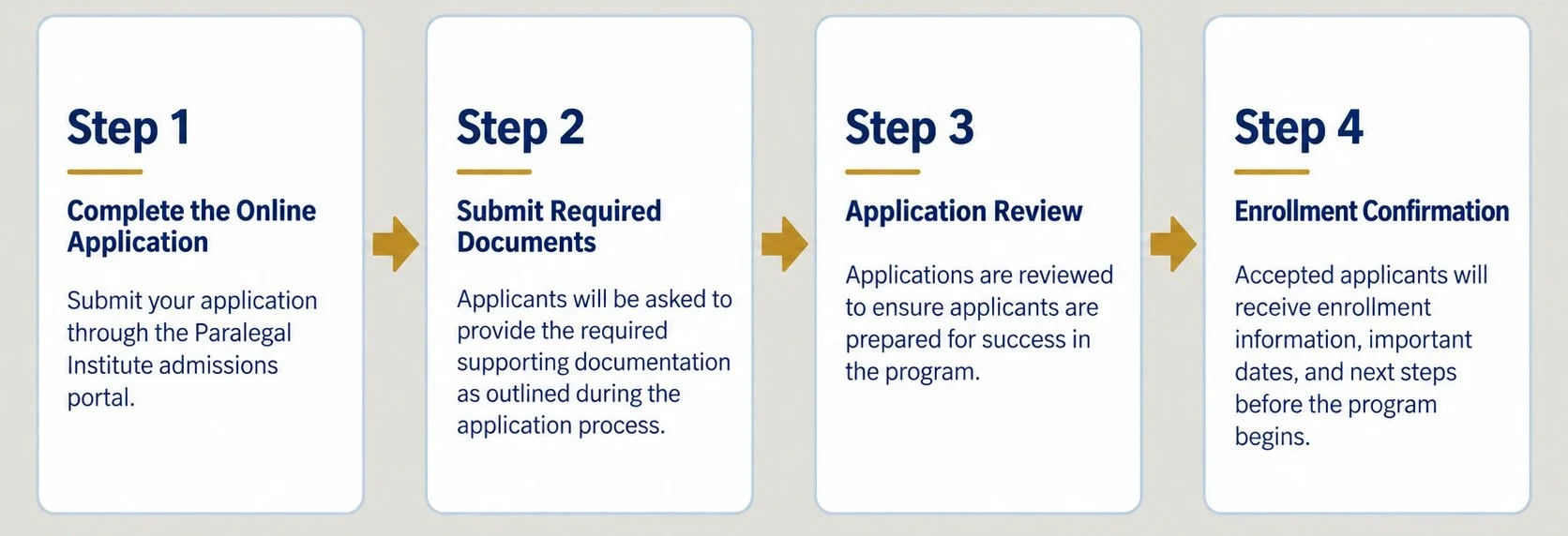
Applying to the Paralegal Institute is a straightforward process designed to help you prepare for a successful learning experience.
Who Should Apply?
The Paralegal Education Program is designed for:
• Individuals beginning a career in the legal profession
• Career changers seeking new professional opportunities
• Current legal support professionals interested in expanding their knowledge and skills
• Administrative professionals seeking career advancement
• Individuals committed to lifelong learning and professional development
Start Your Application Today!
Admission Requirements
Admission requirements are currently being finalized for the inaugural Summer 2027 cohort.
Additional information will be published as enrollment approaches.
If you are interested in joining the first cohort, we encourage you to submit a Request for Information so we can keep you informed of important updates.
Tuition & Payment Information
The Paralegal Institute is committed to providing high-quality, instructor-led professional education at an affordable and accessible cost. Tuition is established to support exceptional instruction, educational resources, and a meaningful learning experience while remaining accessible to individuals pursuing careers in the legal profession.
A detailed tuition schedule for each course and program component will be published prior to the opening of enrollment.
Tuition Payment
To confirm enrollment, tuition payment for each course is due no later than two (2) weeks before the scheduled course start date.
Enrollment is not considered final until payment has been received. Students who do not submit payment by the published deadline may risk losing their reserved seat if the course reaches capacity.
Payment Administration
The Paralegal Education & Training Institute partners with the University Business Center (UBC) at the Craig School of Business, California State University, Fresno, to administer tuition collection and payment processing.
Accepted students will receive payment instructions as part of their enrollment package
Accepted Forms of Payment
Credit and debit cards
Personal or business checks
Employer-sponsored payments
Please contact us for other payment options.
Employer Sponsorship
Many employers support continuing professional development by reimbursing or sponsoring employee education.
Students are encouraged to contact employers concerning their tuition reimbursement policy for education funding.
Scholarship Opportunities
As an independent nonprofit organization, the Paralegal Institute is committed to expanding access to professional legal education. Scholarship opportunities supported through sponsors and community partners will be announced as funding becomes available.
Application Timeline
The Professional Paralegal Education Program follows a structured admissions and enrollment process to ensure students have ample time to prepare for the start of classes.
Applications Open
Applications for each cohort will open several months before the program begins. Prospective students are encouraged to apply early, as enrollment may be limited.
Application Review
Applications are reviewed on a rolling basis. Applicants may be contacted if additional information is needed during the review process.
Enrollment Confirmation
Accepted applicants will receive an official enrollment confirmation along with tuition payment instructions, important deadlines, and orientation information.
Program Begins
Students who have completed all enrollment requirements and submitted tuition payment will begin classes according to the published program schedule.
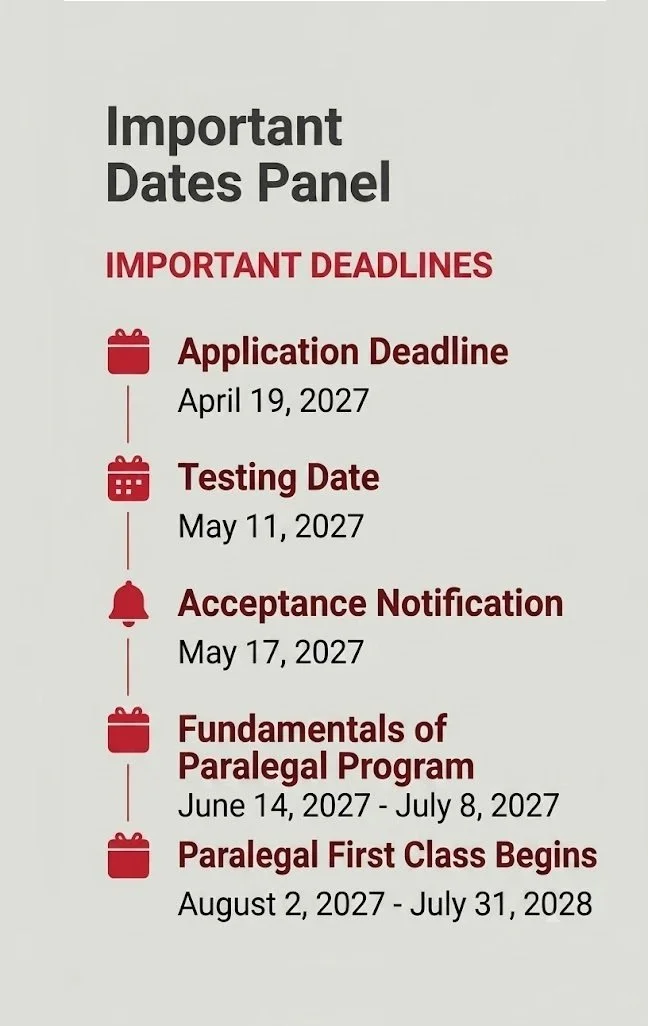
For the inaugural cohort, please refer to the Program Schedule page for the most current dates and deadlines.
Sample Questions
Logical Reasoning Question
When pregnant lab rats are given caffeine equivalent to the amount a human would consume by drinking six cups of coffee per day, an increase in the incidence of birth defects results. When asked if the government would require warning labels on products containing caffeine, a spokesperson stated that it would not because the government would lose credibility if the findings of these studies were to be refuted in the future.
Which of the following is most strongly suggested by the government’s statement above?
(A) A warning that applies to a small population is inappropriate.
(B) Very few people drink as many as six cups of coffee daily.
(C) There are doubts about the conclusive nature of animal studies.
(D) Studies on rats provide little data about human birth defects.
(E) The seriousness of birth defects involving caffeine is not clear.
Analytical Reasoning Question
Buses 1, 2, and 3 make one trip each day, and they are the only ones that riders A, B, C, D, E, F, and G take to work.
Neither E nor G takes bus 1 on a day when B does.
G does not take bus 2 on a day when D does.
When A and F take the same bus, it is always bus 3.
C always takes bus 3.
Traveling together to work, B, C, and G could take which of the same buses on a given day?
(A) 1 only
(B) 2 only
(C) 3 only
(D) 2 and 3 only
(E) 1, 2, and 3
Reading Comprehension LSAT Questions
Many, perhaps most, well-disposed, practical people would, if they had to designate a philosophy that comes closest to expressing their unstated principles, pick utilitarianism. The philosophy that proclaims as its sovereign criterion the procuring of the greatest good of the greatest number has indeed served as a powerful engine of legal reform and rationalization. And it is a crucial feature of utilitarianism that it is consequences that count. Now, it is interesting that some judgments that are actually made in the law and elsewhere do not appear to accord with this thoroughgoing consequentialism. For instance, both in law and morals there are many instances of a distinction being made between direct and indirect intention — i.e., the distinction between on the one hand the doing of evil as an end in itself or on the other hand bringing about the same evil result as a consequence of one’s direct ends or means. So also the distinction is drawn between the consequences that we bring about by our actions and consequences that come about through our failures to act. Also, when bad consequences ensue from our actions and what was done was in the exercise of a right or privilege, the law is less likely to lay those bad consequences at our doorstep. And, finally, if the only way to prevent some great harm would be by inflicting a lesser harm on yourself or on others, then too the law is inclined to absolve us of responsibility for that avoidable greater harm. It is as if the net value of the consequences were not crucial, at least where net benefit is procured by the intentional infliction of harm.
Not only are these distinctions drawn in some moral systems, but there are numerous places in the law where they are made regularly. Since in utilitarianism and consequentialism in general the ultimate questions must always be whether and to what extent the valued end-state (be it happiness or possession of true knowledge) obtains at a particular moment, it is inevitable that the judgments on the human agencies that may affect this end-state must be wholly instrumental: human actions can be judged only by their tendency to produce the relevant end-states.
Indeed, it may well be that even the point and contents of normative judgments — whether legal or moral — are concerned not just with particular end-states of the world but also with how end-states are brought about. These kinds of substantive judgments take the form: there are some things one should just never do — kill an innocent person, falsely accuse a defendant in a criminal proceeding, engage in sex for pay. These are to be contrasted to judgments that this or that is an unfortunate, perhaps terrible, result that (other things being equal) one would want to avoid. The former are — very generally — judgments of right and wrong. It is wrong to do this or that, even if the balance of advantages favors it; a person is right to do some particular thing (help a friend, protect his client’s interests) even though more good will come if he does not.
The author’s point in the passage is primarily that:
(A) Law and utilitarianism are not always compatible.
(B) Utilitarianism is the operating philosophy of most people.
(C) Consequentialism is the basis for legal reform.
(D) Direct and indirect intentions lead to different end-states.
(E) Judgments about human actions can be made only by the resulting end-states.
Which of the following is NOT a feature of utilitarianism?
(A) Results are considered important.
(B) Consequences are considered important.
(C) The valued end-state is considered important.
(D) The means of achieving results are considered important.
(E) The net value of consequences is considered important.
Writing Sample (Sample Only)
Alice Anderson is a senior at John Paul Jones University. She has been offered two positions as a result of her outstanding record in her major, Television and Radio Broadcasting. As her counselor, you are to write an argument favoring one of the two offers. Two considerations guide your decision:
Alice has a large student loan debt that she has to begin to repay immediately upon graduation.
Alice has as her career goal a position as a network news anchorperson.
WAND is the only television station serving a large area located some 250 miles north of the capital of the state. The station has offered Alice a job as a reporter whose principal assignments would be to cover the activities of local governments, politics, and business. In addition to her assigned stories, Alice would have the opportunity to independently prepare stories for possible broadcast. Because the station is small, has a very stable staff, and has limited growth prospects, Alice’s chances for advancement are not good. WAND’s owner is a former network executive who purchased the station in order to get away from the pressures of broadcasting in major markets. Alice would get only a modest salary at WAND, and she would have to supplement her income with outside work.
KBSC is one of three television stations located in the state capital. The station has offered Alice a job as a production assistant in the news department. She would primarily do background research and check facts and sources for the producers and reporters. Production assistants who work hard are promoted to positions as special assignment reporters in about two years. There are many special assignment reporters competing for assignments, most of which involve covering minor events such as political dinners, award ceremonies, and concerts and writing human-interest stories. Most special assignment reporters spend at least five years covering minor events before moving into a position as a general report-anchorperson. KBSC would pay Alice a salary in excess of the amount she would need to live comfortably in the city.
FAQs
Is prior legal experience required?
1
No. The program is designed for individuals entering the legal profession as well as those seeking to expand their existing knowledge.
Is the program offered in person?
2
Program is offered two evenings each week in person (Mondays and Wednesdays) and each Tuesday is a Zoom session. Emphasizes instructor-led, in person learning with Zoom Session midweek.
What credential will I receive?
3
Students who successfully complete all program requirements receive a Professional Certificate in Paralegal Studies issued by the paralegal institute.
Is the certificate for college credit?
4
No. The Paralegal Institute’s Professional Certificate is non-credit bearing and does not confer university academic credit.
Contact Us
Choosing the right educational pathway is an important decision, and we're here to help. Whether you have questions about the program, the admissions process, or what to expect as a PETI student, we'd be happy to hear from you.
We look forward to learning more about your goals and helping you determine if PETI is the right fit for your professional future.